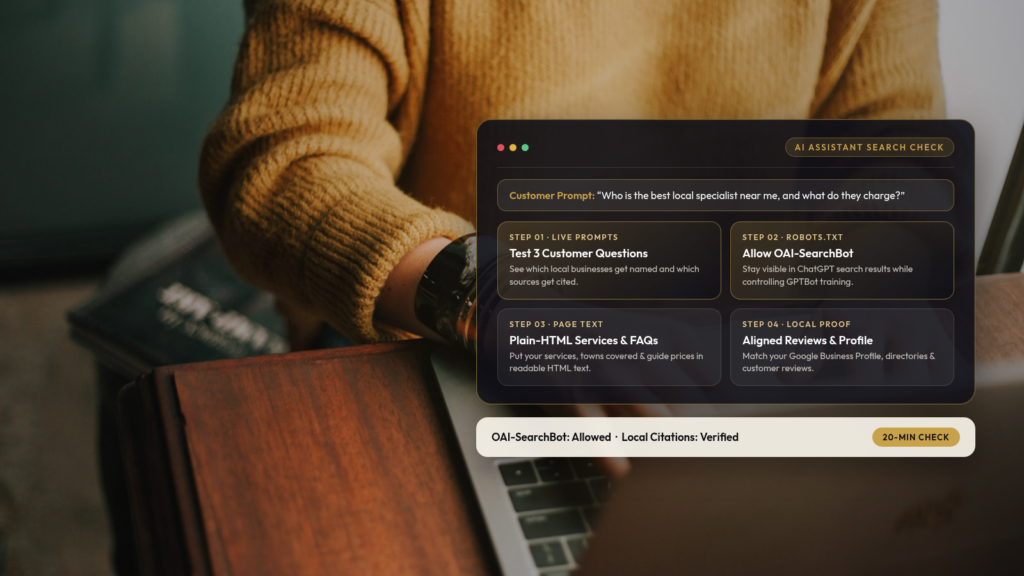
A growing number of customers aren’t typing two word searches into Google and opening ten tabs anymore. Instead, they’re opening ChatGPT, Perplexity, or Google’s AI mode on their phone and asking a full question:
“Who’s a reliable emergency plumber in south Birmingham?”
“Best independent restaurant in Solihull that sells gift vouchers?”
“Which clinic near me does sports massage with evening appointments?”
Instead of ten blue links, they get a shortlist of three or four named businesses, along with a sentence explaining why each one was picked.
You don’t need expensive “AI SEO” software to find out whether ChatGPT recommending your business is even on the cards. Most of what helps an AI assistant recommend a local business is the exact same groundwork that helps real human customers trust you. Here is a 20 minute check you can run today with the kettle on.
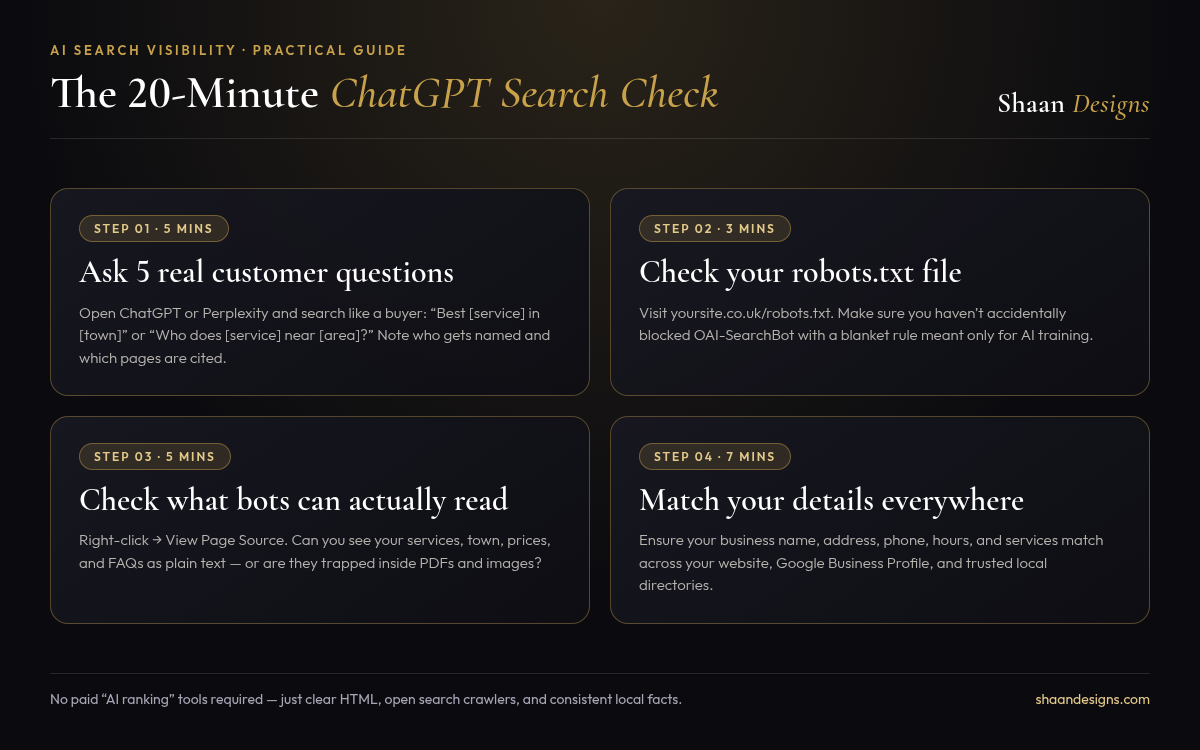
Step 1: Ask five real customer questions (5 minutes)
Open ChatGPT (with web search turned on) and ask five questions a real customer would ask before buying from you, without typing your business name.
- “Best [what you do] in [your town or neighbourhood]”
- “Where can I book [your main service] in [your area]?”
- “Who does [specific job, e.g. boiler servicing / afternoon tea gift vouchers] near [town]?”
Don’t just look at whether your name pops up. Look closely at which websites and directories get cited at the bottom of the answer. Is it pulling from local guides, Yell, Checkatrade, Tripadvisor, or directly from competitors’ service pages? That tells you where the assistant is looking for proof in your industry.
Step 2: Check whether you’ve accidentally locked the door in robots.txt (3 minutes)
In a browser tab, go to yoursite.co.uk/robots.txt (replace with your own domain).
Over the past couple of years, lots of well meaning plugins and security guides advised business owners to “block all AI bots” to stop their writing being used for AI training. The catch is that blocking every AI user agent can also stop ChatGPT’s live search crawler from reading your site when a customer asks for a recommendation.
According to OpenAI’s official crawler documentation, they use separate bots for separate jobs:
OAI-SearchBotis used to surface and link to websites in ChatGPT’s search results.GPTBotis used to crawl content for training OpenAI’s generative AI models.
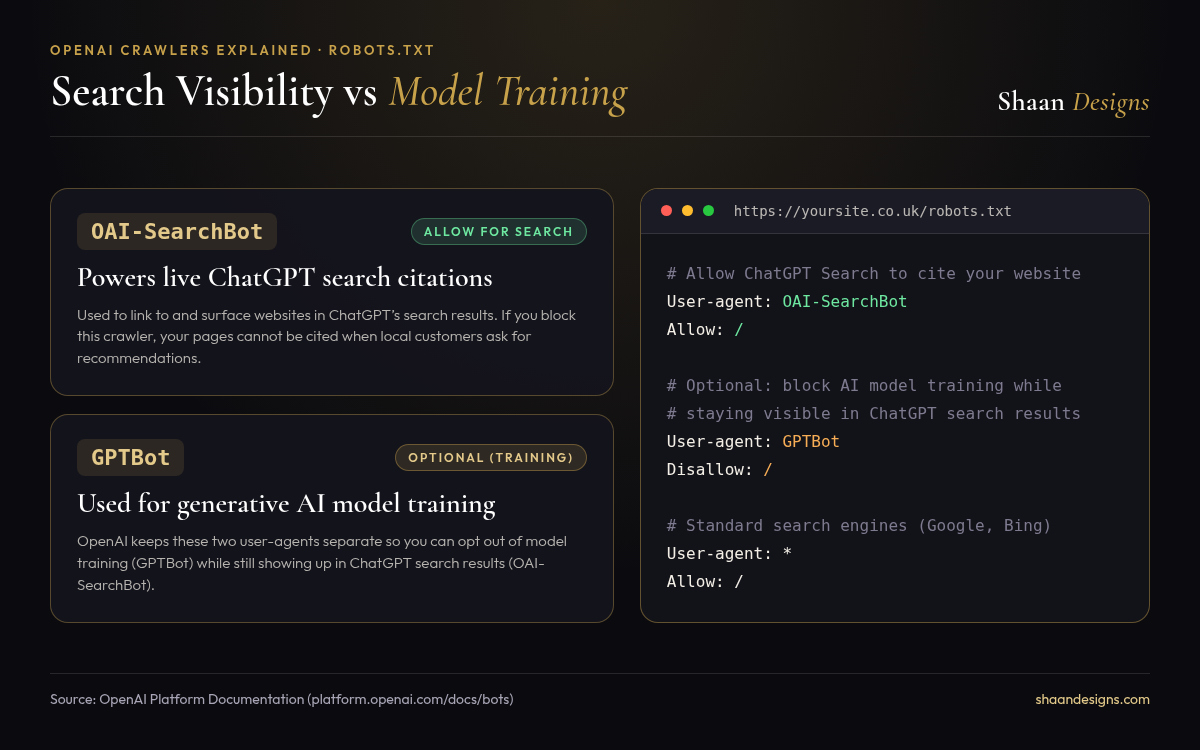
If your robots.txt has Disallow: / under OAI-SearchBot (or blocks every crawler indiscriminately), ChatGPT’s search feature isn’t allowed to cite your website.
Step 3: Check what a bot can actually read on your homepage (5 minutes)
Open your homepage on a laptop, right click anywhere on the page, and click View Page Source. Now press Ctrl+F (or Cmd+F on a Mac) and search for:
- Your main service
- The town or areas you cover
- Your starting prices or opening hours
Can you find those words in the raw HTML? We regularly audit local websites where the menu, price list, or service breakdown only exists inside a scanned PDF, an image banner, or a heavy JavaScript widget that loads after the page. A human might click three times to open your PDF menu, but search crawlers and AI assistants strongly prefer clear, plain HTML text: proper headings, a plain English FAQ section, and one dedicated page per core service.
Step 4: Make your facts match everywhere outside your website (7 minutes)
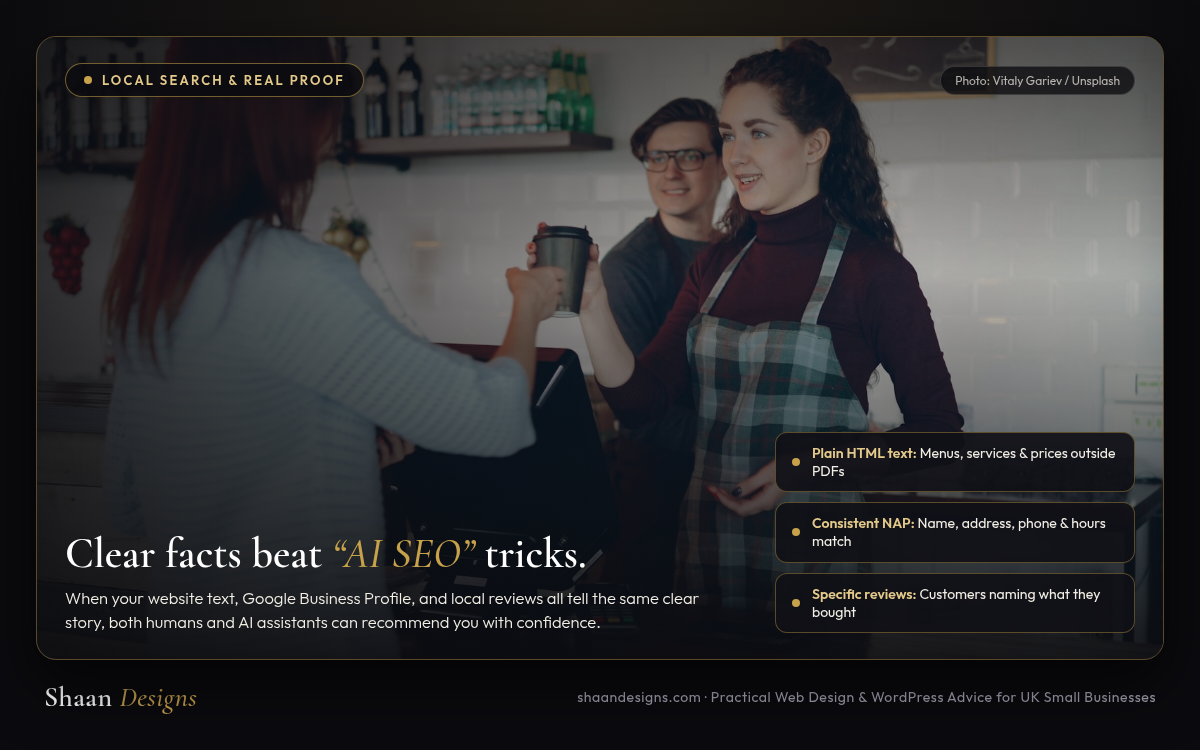
When an AI assistant recommends a local business, it cross checks your website against the rest of the web. Spend seven minutes checking that your core details match word for word across:
- Your website footer and contact page
- Your Google Business Profile (opening hours, service list, and website link)
- Your main industry directory (Tripadvisor, OpenTable, Checkatrade, Fresha, or Yell)
- Your social media bios
And when you ask happy customers for a Google review, encourage them to mention what they actually bought or booked (“brilliant boiler service in Harborne” tells both humans and search tools far more than “great service, thanks!”).
Want us to check how your website looks to Google and AI search?
Send over your website address and the town you cover. We’ll check your robots.txt, page structure, and local search foundations and tell you in plain English what’s helping and what’s holding you back.